Guides
What US packaged food labels must show for nutrition, allergens, ingredients and net weight
A practical guide to the Nutrition Facts panel, small business exemption, allergen declarations, ingredient statements, net weight and state fill checks.
What to take away
- A Nutrition Facts panel is required on most retail packaged food; the small business exemption narrows the panel, never the ingredient list, allergen statement or net weight.
- The nine major allergens must appear by common name, either inside the ingredient statement or in a Contains line directly beneath it.
- State weights and measures officials sample your fill weights; California and New York run their own programs and can order a stop-sale.
- An organic claim requires USDA AMS certification and the certifying agent's name on the information panel, with no exemption for small producers.
- Lock the formula before you approve artwork, because every reformulation invalidates printed stock.
Which packaged foods need a Nutrition Facts panel
The panel is required on most food offered for sale to consumers. Exemptions exist, and they are narrower than new makers assume.
Small Business Exemption Thresholds
- 100full-time equivalent employees
- 100,000units sold in US per year
- Panel onlyingredient, allergen, net weight still apply
The FDA food hub carries the current rule text: Food | FDA.
The small business exemption
A firm with fewer than 100 full-time equivalent employees and under 100,000 units sold in the US in a year may qualify for a simplified panel or relief from some nutrient declarations.
That relief touches the panel only. The ingredient statement, allergen declaration and net weight still apply at any size.
Restaurants and food service sit outside retail labelling. Once a jar or pouch reaches a retail shelf, retail rules follow it.
What the panel carries
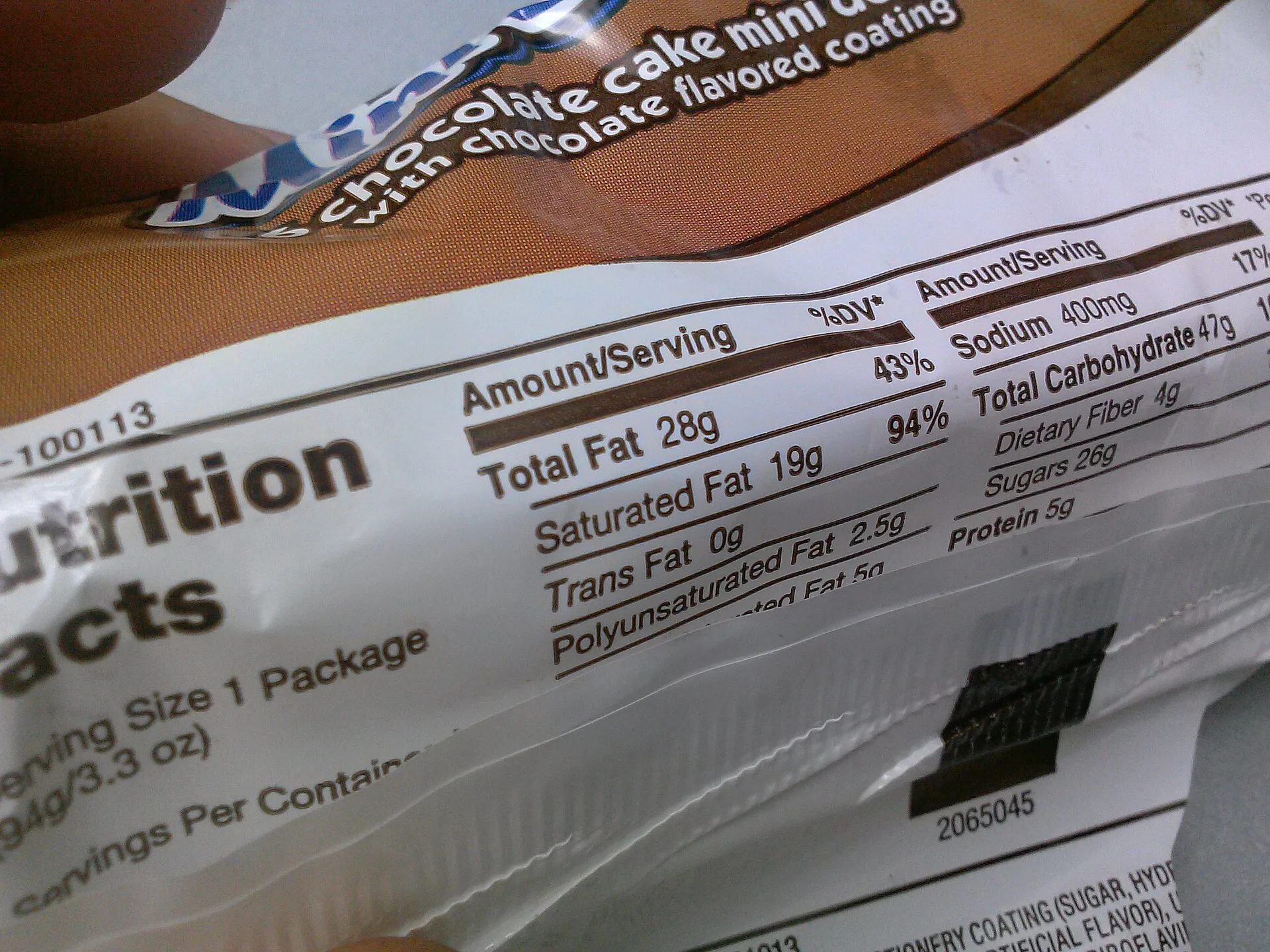
The panel runs serving size, servings per container, calories, and total fat.
It also runs saturated fat, trans fat, cholesterol and sodium. Then total carbohydrate, dietary fiber, total sugars, added sugars and protein. Vitamin D, calcium, iron and potassium close it.
Serving size is not yours to choose. It comes from the reference amount customarily consumed for that food category.
A dry mix that gets prepared may need a second column for prepared values. That catches many dry-blend makers on the first print run.
When the panel can shrink or disappear
Very small packages may use an abbreviated format with a phone number or address for requesting full information.
Foods sold for further processing, and bulk ingredients, are exempt because the finished label will carry the panel.
Write down your exemption reasoning. A memo citing the rule answers a buyer or inspector faster than a verbal explanation.
Allergen statements and cross-contact controls
Nine allergens fall under the labelling rules:
Two Acceptable Allergen Declarations
In ingredient list
- Example
- whey (milk)
- Placement
- Inside ingredient list
- Both allowed
- Yes
- Separated by other info
- No
Contains statement
- Example
- Contains: milk, wheat, soy
- Placement
- Right after ingredient list
- Both allowed
- Yes
- Separated by other info
- No
Each must be declared by common name. "Natural flavour" does not cover an allergen, and neither does "spices."
Two acceptable declarations
- Name the allergen inside the ingredient statement, as in "whey (milk)".
- Add a Contains statement immediately after the ingredient list, as in "Contains: milk, wheat, soy."
Both is fine. Neither is not. A Contains statement cannot be separated from the ingredient list by other information.
Advisory statements
"May contain" and "produced in a facility that also handles" are voluntary. They do not replace cleaning and controls.
FDA expects advisory statements only where a real risk survives reasonable controls. Blanket warnings on everything weaken the signal and draw scrutiny.
Build allergen control into your food safety plan: changeover records, dedicated utensils, wet cleaning validation, storage segregation.
Allergen declarations are one line in the wider set of licences and obligations that start once you sell wholesale.
If you are still setting up, work through a compliance checklist for new owners before approving final artwork.
Net weight, drained weight and state fill checks
Every retail package carries a net weight declaration in the lower third of the principal display panel, in both metric and US customary units.
State Fill Check Sequence
- Sample packages from shelf and warehouse
- Apply statistical sampling plan
- Lot average must meet declared amount
- No package below allowed variation
- Short fill triggers stop-sale and penalties
Net quantity means the food alone. It excludes the jar, the brine, the syrup and the packaging.
Products packed in liquid may also need a drained weight statement: what remains after the liquid is removed under standard conditions.
How states check fill
State weights and measures officials sample packages from retail shelves and from your warehouse, using statistical sampling plans.
Two tests apply. The lot average must meet or exceed the declared amount, and no single package may fall short by more than the allowed reasonable variation.
California runs its own program through the Division of Measurement Standards: CDFA - Division of Measurement Standards.
New York runs its own through the Department of Agriculture and Markets: Weights & Measures | Agriculture and Markets.
Both are large markets and both are active on packaged food weights. A short fill in either can trigger a stop-sale, a rework order and civil penalties.
Filling to target, not to label
Set the filler above the declared weight. The gap absorbs normal variation in piece size, density and fill temperature.
Check fill at the start, middle and end of every run, and record the numbers. A drifting average found by an inspector is a worse day than one found on your own scale.
Worked example: a 12 oz jar of tomato sauce
Declare 340 g (12 oz) and set the filler target at 348 g. A sample of 20 jars averaging 345 g passes the average test.
One jar at 331 g is 9 g short. Whether it fails depends on the reasonable variation allowed for that package size.
If the allowed variation is 6 g, that jar is out of tolerance. One outlier in a small sample can fail the lot, so keep the target generous and the records tight.
Ingredient statements and order of predominance
Ingredients are listed by weight, most to least, as they go into the product. Added water counts in that ranking.
Building the Ingredient Statement
- List by weight, most to least
- Count added water in ranking
- Put sub-ingredients in parentheses
- Use common or usual names
- Group items at 2% or less at end
Sub-ingredients appear in parentheses in descending order within the parent ingredient, so a compound sauce or blend carries its own mini list.
Common names
Use the common or usual name. "Sugar" is fine, "sweetener" is not. Say wheat flour when that is what you use.
Chemical names are allowed where they are the common name. You cannot invent a friendlier term to avoid an unpopular word.
Ingredients at 2 percent or less may be grouped at the end under "Contains 2% or less of:" in any order among themselves.
Colors, preservatives and incidental additives
Certified colors are declared by name. Some preservatives must carry a function, as in "sodium benzoate (preservative)".
Incidental additives with no technical effect in the finished food, present at insignificant levels, may be exempt from declaration. The exemption is narrow and never covers an allergen.
Formula changes invalidate print stock
Every formula change is a label change. Swapping one starch for another, or dropping a preservative, makes the printed stock wrong.
The ingredient statement is also the first thing a retail buyer checks against the sell sheet buyers will review, so keep both documents aligned.
Organic claims and USDA AMS certification
Organic claims are governed by the USDA organic regulations, administered by the Agricultural Marketing Service: Organic Regulations | Agricultural Marketing Service.
Four Organic Claim Tiers
100% organic
- Organic content
- 100%
- Certification
- Yes
- USDA seal
- Allowed
- Front panel claim
- Yes
Organic
- Organic content
- 95% or more
- Certification
- Yes
- USDA seal
- Allowed
- Front panel claim
- Yes
Made with organic
- Organic content
- 70% or more
- Certification
- Yes
- USDA seal
- Not allowed
- Front panel claim
- Yes
Ingredient listing only
- Organic content
- Under 70%
- Certification
- No
- USDA seal
- Not allowed
- Front panel claim
- No
Selling a product labelled organic requires certification. There is no small-producer exemption for retail packaged goods.
The four claim tiers
Minimum organic content
- "100% organic"
- 100% organic ingredients
- "Organic"
- At least 95% organic ingredients
- "Made with organic [ingredients]"
- At least 70% organic ingredients
- Organic ingredient listing only
- Less than 70% organic
Certification needed
- "100% organic"
- Yes
- "Organic"
- Yes
- "Made with organic [ingredients]"
- Yes
- Organic ingredient listing only
- No, and no front-panel organic claim
Products in the 70 to 95 percent band may list organic ingredients on the information panel and state the percentage. They may not use the USDA organic seal.
What must appear on pack
The certifying agent's name goes on the information panel. The USDA organic seal is allowed at 95 percent and above.
Reproduce the seal correctly. A distorted, recolored or hand-drawn seal is a compliance problem, not a design choice.
Records behind the claim
Hold organic certificates for every ingredient, a supply chain audit trail, and a system that keeps organic and conventional lots apart.
Certifiers audit annually, reading receiving logs, production records, cleaning records and finished goods. Organic volume that outpaces certified ingredient purchases is the finding that ends a certification.
Country of origin and FTC claim substantiation
COOL rules are administered by AMS: Country of Origin Labeling (COOL) | Agricultural Marketing Service.
Mandatory COOL covers a defined commodity list:
Mandatory COOL vs Processed Foods
Mandatory COOL
- Covered
- Beef, pork, lamb, chicken
- Seafood
- Wild and farm-raised
- Produce
- Perishable commodities
- Nuts
- Macadamia, pecans, peanuts
- Origin claim
- Required
Most processed specialty foods
- Covered
- Outside the list
- Seafood
- Not covered
- Produce
- Not covered
- Nuts
- Not covered
- Origin claim
- Still must be substantiated
Most processed specialty foods fall outside that list. Origin claims are still not free, because a "Made in USA" claim is a marketing claim and must be substantiated.
What "Made in USA" requires
All or virtually all of the product must be made in the United States. For food, that means the significant ingredients and the processing are domestic.
A product assembled here from imported ingredients is safer with a qualified claim, such as "Made in USA with imported ingredients".
FTC claims you should expect to defend
Advertising claims, on your website, social media and sell sheets, fall under Federal Trade Commission standards rather than FDA labelling rules.
Every objective claim needs substantiation in hand before it runs. "All natural", "no preservatives", "low sodium" and "supports immunity" carry different burdens.
Structure function claims about health need specific wording and sometimes a disclaimer. Disease claims turn the product into a drug.
Keep a claim file: the test report, supplier certificate or published study behind each claim. If you cannot produce it on request, drop the claim.
Label review before your first retail shipment
Label work is mostly sequence. Artwork approved before the formula is locked is the most common source of expensive reprints.
Run these in order, and release no printed stock until every box is ticked.
- Lock the formula and the process, including any ingredient that carries an allergen.
- Generate the Nutrition Facts panel from a laboratory analysis or a validated database calculation for that formula.
- Draft the ingredient statement in descending order by weight, with sub-ingredients in parentheses.
- Write the allergen declaration and decide whether it sits in the ingredient list, in a Contains statement, or both.
- Set net weight and drained weight, then confirm the filler target sits above the declared figure.
- Confirm any organic, origin or health claim and file the substantiation behind it.
- Send the complete artwork to a qualified reviewer, then to the printer.
Pre-shipment checklist
Pre-Shipment Label Checklist
- Nutrition Facts matches current formula
- Allergens declared by common name
- Net weight in metric and US units
- Drained weight shown if packed in liquid
- Ingredients in descending order by weight
- Organic certifier named on information panel
Keep the file audit ready
Hold approved artwork, nutrition documentation, the allergen risk assessment and fill records in one folder. A buyer audit or a state inspection should be answerable from it.
Owners who treat label review as part of specialty food customer acquisition catch artwork errors before print rather than after a recall.
The wider set of paperwork a specialty food business needs covers facility registration, state food licensing and your food safety plan, all of which reference the label.
Common questions
Do I need a Nutrition Facts panel if I sell only at farmers markets?
It depends on your volume and how the product is sold. Many small direct-sale operations qualify for an exemption, but the ingredient statement, allergen declaration and net weight still apply once the product is packaged.
Can I put "may contain" on everything to be safe?
You can, but FDA expects advisory statements to reflect a real risk that survives your allergen controls. Blanket warnings on products with no plausible cross-contact invite scrutiny and dilute the warning for shoppers who need it.
Does a small producer need organic certification?
Yes, if the product carries an organic claim on the principal display panel or in the product name. Certification is required regardless of size, and the certifying agent must be named on the information panel.
Who actually checks my net weight?
State weights and measures officials, sampling at retail and at your facility. California and New York operate their own active programs, and short fills can lead to stop-sale orders and penalties.